Saturday, July 10, 2010
Jumping around...
Several things on my mind this morning, so indulge me as I jump from one blog-related (more or less) topic to another:
Defending Microsoft
Why do I find myself continually defending Bill Gates and Microsoft, as if they need my help? I know it is popular to pick on them because of their size, wealth, power and oft-times obtuse behavior. But I wonder where computers would be today if Bill had not semi-swiped that first OS code and made it possible for the average guy to put truly amazing computing power on his desktop. Yes, someone else would have done it if he had not. And people would have hated him, too.
Need I remind folks again that Windows has to work on an almost infinite array of hardware, and perform with an unbelieveably large number of software apps? And that there is a massive sub-culture out there bent on finding holes in the system and ways to break it? Trying to stay ahead of that bunch of inglorious bastards is one reason Microsoft has to continue upgrading, fixing holes, making things more complicated for us law-abiding users.
(And you self-righteous Apple bigots: Apple is hardware. They only have to write and upgrade an OS that works on their hardware. Developers write apps for their hardware and OS, not something that has to work with an almost infinite variation of hardware. Where are the SOBs who want to go after the smugness and self-importnce of Apple? I don't understand. They are rich and powerful, too. Just not as rich and powerful as Bill and his little software company.)
Heat affecting FM radio
The latest excuse coming from broadcasters to explain why ratings are diminishing? It's too hot! Yes, the heat wave on the East Coast has caused listeners to have a harder time pulling in the FM stations. Somehow, the heat is sapping the signals.
Huh? First I have heard of this phenomenon. Stations in Arizona and Florida have never--to my knowledge--noticed such a thing. No, it is more likely that the heat has kept people inside more, not in their cars, where traditional terrestrial radio still has an advantage over other media.
Can anyone enlighten me? Can a temperature 10 degrees above normal affect FM broadcast radio signals enough to keep someone from being able to listen to a station?
Every vote counts--for a hundred thousand people
As the good folks at Arbitron continue to give value to their expensive ratings, they are allowing subscribers to carve up their data thinner and thinner. When interfaced with the Selector music scheduling system, program directors can see exactly what happened to their "audience" when a particular song played at a specific time of day, down to the minute.
Beautiful! You play the latest Lady Gaga and the numbers dive. You drop the song and play something else that showed a healthy spike the last time you played it. Everybody's happy, right?
How goofy is that? When you carve up the ratings so fine, you are depending on a very, very small sample base. See, Arbitron relies on a panel of people who have agreed to carry their portable people meter, which can tell what radio station the volunteer is listening to at any moment. In a city the size of Birmingham, Alabama, there may be only 800 people participating as panel members. That means every person is representing almost 1,300 people's radio listening.
But in some very narrow demo groups (say, African-American women, 18 to 24 years old) one person could represent a far larger percentage of the group. If that one person stops listening when the Lady Gaga song comes on, the needle dips and the program director panics. Never mind that the one meter-carrier actually loves the song but arrived at work, or had to turn own the radio because she was at the drive-through at Wendy's. But based on her actions, neither she nor all the others who like the song will hear it again on that station.
I'm a data guy. Research is a wonderful thing. But this is just plain goofy!
Agree?
Don Keith N4KC
http://www.n4kc.com/
http://www.donkeith.com/
www.facebook.com/donkeith
www.twitter.com/don_keith
Defending Microsoft
Why do I find myself continually defending Bill Gates and Microsoft, as if they need my help? I know it is popular to pick on them because of their size, wealth, power and oft-times obtuse behavior. But I wonder where computers would be today if Bill had not semi-swiped that first OS code and made it possible for the average guy to put truly amazing computing power on his desktop. Yes, someone else would have done it if he had not. And people would have hated him, too.
Need I remind folks again that Windows has to work on an almost infinite array of hardware, and perform with an unbelieveably large number of software apps? And that there is a massive sub-culture out there bent on finding holes in the system and ways to break it? Trying to stay ahead of that bunch of inglorious bastards is one reason Microsoft has to continue upgrading, fixing holes, making things more complicated for us law-abiding users.
(And you self-righteous Apple bigots: Apple is hardware. They only have to write and upgrade an OS that works on their hardware. Developers write apps for their hardware and OS, not something that has to work with an almost infinite variation of hardware. Where are the SOBs who want to go after the smugness and self-importnce of Apple? I don't understand. They are rich and powerful, too. Just not as rich and powerful as Bill and his little software company.)
Heat affecting FM radio
The latest excuse coming from broadcasters to explain why ratings are diminishing? It's too hot! Yes, the heat wave on the East Coast has caused listeners to have a harder time pulling in the FM stations. Somehow, the heat is sapping the signals.
Huh? First I have heard of this phenomenon. Stations in Arizona and Florida have never--to my knowledge--noticed such a thing. No, it is more likely that the heat has kept people inside more, not in their cars, where traditional terrestrial radio still has an advantage over other media.
Can anyone enlighten me? Can a temperature 10 degrees above normal affect FM broadcast radio signals enough to keep someone from being able to listen to a station?
Every vote counts--for a hundred thousand people
As the good folks at Arbitron continue to give value to their expensive ratings, they are allowing subscribers to carve up their data thinner and thinner. When interfaced with the Selector music scheduling system, program directors can see exactly what happened to their "audience" when a particular song played at a specific time of day, down to the minute.
Beautiful! You play the latest Lady Gaga and the numbers dive. You drop the song and play something else that showed a healthy spike the last time you played it. Everybody's happy, right?
How goofy is that? When you carve up the ratings so fine, you are depending on a very, very small sample base. See, Arbitron relies on a panel of people who have agreed to carry their portable people meter, which can tell what radio station the volunteer is listening to at any moment. In a city the size of Birmingham, Alabama, there may be only 800 people participating as panel members. That means every person is representing almost 1,300 people's radio listening.
But in some very narrow demo groups (say, African-American women, 18 to 24 years old) one person could represent a far larger percentage of the group. If that one person stops listening when the Lady Gaga song comes on, the needle dips and the program director panics. Never mind that the one meter-carrier actually loves the song but arrived at work, or had to turn own the radio because she was at the drive-through at Wendy's. But based on her actions, neither she nor all the others who like the song will hear it again on that station.
I'm a data guy. Research is a wonderful thing. But this is just plain goofy!
Agree?
Don Keith N4KC
http://www.n4kc.com/
http://www.donkeith.com/
www.facebook.com/donkeith
www.twitter.com/don_keith
Wednesday, July 7, 2010
If you had to give up...
There's a column in the current issue of POPULAR COMMUNICATIONS magazine that does some mean speculating. It is based on the old premise of if you were stranded on a desert island, what food -- music -- books -- whatever -- would you want to have with you. Well, it turns out that my old friends at Arbitron and Edison Research have done a similar study, asking people what medium they would prefer giving up if forced to choose, television or the Internet.
Does it surprise anyone that the answers break out neatly along generational lines? Those born from 1945 to about 1965 don't even hesitate. The Internet is gone baby gone. Those born after 1965, and who came of age with the advent of the web, would kick the TV set to the curb in a heartbeat.
It would be very interesting to give respondents more choices. How many, if required to do so, would keep their cell phones to the exclusion of everything else? Their satellite TV? Their wi-fi?
How many of them would choose radio? No, don't answer that!
As I watch how quickly new technology like smart phones is assimilated by younger people today, I wonder just how quickly the pace of technological and communications advances will accelerate. Companies depend on creating buyers for ever-changing products. Unlike dishwashing detergent or ketchup, we have a generation that not only wants something new all the time but that demands it. They are quick to abandon anyone who does not innovate...or at least give the appearance of being out there, leading the pack.
Have these companies created a beast they will have trouble feeding? Or is there room--technologically and economically--for ever-growing advancement? That is, if there are enough visionaries to keep coming up with ideas, enough venture capitalists to stoke the furnace, and enough potential buyers to make it rewarding.
Don Keith N4KC
http://www.n4kc.com/
http://www.donkeith.com/
www.facebook.com/donkeith
Does it surprise anyone that the answers break out neatly along generational lines? Those born from 1945 to about 1965 don't even hesitate. The Internet is gone baby gone. Those born after 1965, and who came of age with the advent of the web, would kick the TV set to the curb in a heartbeat.
It would be very interesting to give respondents more choices. How many, if required to do so, would keep their cell phones to the exclusion of everything else? Their satellite TV? Their wi-fi?
How many of them would choose radio? No, don't answer that!
As I watch how quickly new technology like smart phones is assimilated by younger people today, I wonder just how quickly the pace of technological and communications advances will accelerate. Companies depend on creating buyers for ever-changing products. Unlike dishwashing detergent or ketchup, we have a generation that not only wants something new all the time but that demands it. They are quick to abandon anyone who does not innovate...or at least give the appearance of being out there, leading the pack.
Have these companies created a beast they will have trouble feeding? Or is there room--technologically and economically--for ever-growing advancement? That is, if there are enough visionaries to keep coming up with ideas, enough venture capitalists to stoke the furnace, and enough potential buyers to make it rewarding.
Don Keith N4KC
http://www.n4kc.com/
http://www.donkeith.com/
www.facebook.com/donkeith
Saturday, July 3, 2010
"Facing" Technology
In the face of rapid technological innovation--when there are more and more gimmicks and gadgets to capture our imagination and dollars--we sometimes forget what that technology is supposed to do. What it means to real people doing real things in a real world.
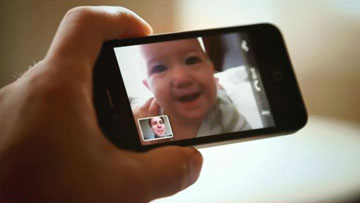
Here is an example. The iPhone is a cell phone, right? It is a gadget, and people migrate to it and line up to buy new versions of it--even if the antenna doesn't work right sometimes. But the people at Apple realize something very important. No matter how many Gs it accesses or what the data bit transfer rate is or how easily it can acquire a cell site, it is far more to their customers than a telephone/game device/camera/GPS. Watch this video, and than I want to compare this to another technology that is near and dear to my heart:
http://www.youtube.com/apple#p/u/2/R1wbQdVezio
Now, let's talk about broadcasting. And by that, I mean traditional, over-the-air radio and TV. How do the guys who have the keys to these stations reach to the heart of their customers, their listeners and viewers? By playing "the best of the 70s, 80s, 90s and today?" By "playing more of your favorites without commercials?" By running promos with "The Night Team" out on the street (where they NEVER are!), coatless, tie undone, shoving a microphone into the face of a firefighter?
When has radio truly offered companionship, a shared experience? When has your local TV station done something that met a real need for a significant number of its potential viewers? When have broadcasters truly done something that reached the hearts of the people they purport to serve?
When have they done what Apple is doing and used their technology to do anything more than try to jack the ratings?
Don Keith
http://www.donkeith.com/
http://www.n4kc.com/
www.facebook.com/donkeith
Here is an example. The iPhone is a cell phone, right? It is a gadget, and people migrate to it and line up to buy new versions of it--even if the antenna doesn't work right sometimes. But the people at Apple realize something very important. No matter how many Gs it accesses or what the data bit transfer rate is or how easily it can acquire a cell site, it is far more to their customers than a telephone/game device/camera/GPS. Watch this video, and than I want to compare this to another technology that is near and dear to my heart:
http://www.youtube.com/apple#p/u/2/R1wbQdVezio
Now, let's talk about broadcasting. And by that, I mean traditional, over-the-air radio and TV. How do the guys who have the keys to these stations reach to the heart of their customers, their listeners and viewers? By playing "the best of the 70s, 80s, 90s and today?" By "playing more of your favorites without commercials?" By running promos with "The Night Team" out on the street (where they NEVER are!), coatless, tie undone, shoving a microphone into the face of a firefighter?
When has radio truly offered companionship, a shared experience? When has your local TV station done something that met a real need for a significant number of its potential viewers? When have broadcasters truly done something that reached the hearts of the people they purport to serve?
When have they done what Apple is doing and used their technology to do anything more than try to jack the ratings?
Don Keith
http://www.donkeith.com/
http://www.n4kc.com/
www.facebook.com/donkeith
Wednesday, June 16, 2010
When American business led the world
There was a time when America was the envy of the world when it came to technology, manufacturing, entertainment and about every other category. We still are, to some extent, but I can point to many industries where that is not even remotely true. Look at automobile manufacturing. GM and
Ford have long since been surpassed by Toyota, Honda, Hyundai and Mercedes Benz. And now that particular business has come almost full circle and are now building cars in major plants in the US...many of them within a few hours' drive of where I live.
Here's another example that is near and dear to my heart. I remember when American radio broadcasting was undeniably the leader in the world. Our free-enterprise system--as opposed to government ownership of media so prevalent in most other countries--led to creativity and innovation. If, for a second, you think it is still that way, then click HERE and watch the interview linked in the middle of the page.
I had the pleasure of traveling to Australia several years ago and visiting with many Australian broadcasters. They were full of questions about media in the USA, how we did it, what we thought the future held.
Based on the linked interview with an exec from Austereo, a large broadcaster in Australia, it appears we should be full of questions for THEM!
Don Keith
http://www.donkeith.com/
http://www.n4kc.com/
www.facebook.com/donkeith
Ford have long since been surpassed by Toyota, Honda, Hyundai and Mercedes Benz. And now that particular business has come almost full circle and are now building cars in major plants in the US...many of them within a few hours' drive of where I live.
Here's another example that is near and dear to my heart. I remember when American radio broadcasting was undeniably the leader in the world. Our free-enterprise system--as opposed to government ownership of media so prevalent in most other countries--led to creativity and innovation. If, for a second, you think it is still that way, then click HERE and watch the interview linked in the middle of the page.
I had the pleasure of traveling to Australia several years ago and visiting with many Australian broadcasters. They were full of questions about media in the USA, how we did it, what we thought the future held.
Based on the linked interview with an exec from Austereo, a large broadcaster in Australia, it appears we should be full of questions for THEM!
Don Keith
http://www.donkeith.com/
http://www.n4kc.com/
www.facebook.com/donkeith
Wednesday, June 9, 2010
Hodge podge post

Necessarily a hodge podge of a post again to catch up on a couple of topics. Anybody excited about the new Apple iPhone? Sure got lots of press (including the problems getting their wi-fi to work at the debut event!), and early adopters are saying it gives Apple a good year's lead over anybody else out there.
Radio laments that it does not include an FM tuner, much less a digital radio capability. The fact that a cloud-computing hookup to iTunes is imminent further gives broadcasters the shakes. The time is coming when, if your only goal is to listen to the songs you want to hear, all you need is a telephone. A telephone that can be hooked to your computer, your home audio system, or your car stereo. And you can either buy or "rent" the songs. How can radio trump this? By touting "the biggest variety of your favorites?" Bigger variety than, well, infinity?
I still wonder how long the exclusivity with iPhone and ATT will last. ATT's customer service continues to be about as popular as BP. I think the continued pushing of the envelope by iPhone is only shoving other manufacturers to do more and more.
How much longer do we continue to call these things "telephones?"
Another topic: considerable debate in amateur radio circles about whether the guys who use Morse code decoders to receive and interpret CW, and keyboards instead of "bugs" or paddles to send it, are really "doing Morse code." An article in the latest ARRL Contest Bulletin points out that the very first Morse code was actually "read" on a machine before it occurred to anyone that the human being was capable of hearing and interpreting the dots and dashes.

That revelation does not settle the controversy, of course. I say, what does it matter. I enjoy the mode very much, primarily because it enables us to make contacts that might not otherwise be made.
Oh, and it is fun!
Don Keith N4KC
http://www.n4kc.com/ (website update in the works...standby!)
Saturday, May 29, 2010
Catching up

Couple of topics on my mind this thundery morning in the southeast...one to do with media and another related to ham radio.
TOPIC 1 -- Radio ratings are killing radio
The oft-quoted Mark Ramsey has a great video on his blog this morning on this topic, and Mark flatly states that is the case, that ratings are killing radio broadcasting. Even if you are not into media, it is a thought-provoking commentary, even if Mark does look a little like he has been working on the piece all dang night!
Here, with some elaboration, was my comment on his piece posted to his blog. Ratings are a tool. An RF ammeter in a radio station's transmission line is a tool to make sure the station does not break FCC rules. The computer and software package a radio station uses to keep track of billings and to send out invoices each month are tools to help the station do business. Ratings are a tool to help a station estimate what its listenership is, to help make programming decisions, and to help market the station to potential advertisers.
If the station uses a slight deflection in the meter readings to decide that, since it is reading incorrectly, they will arbitrarily double the power to make up for it, is that appropriate? If the station determines that the billing software has an error and it is charging customers 15% too much, do they simply keep going and not fix it?
Same with ratings data. So long as rating estimates are not the sole reason for making decisions, or the only benefit a station can present to a potential sponsor, then they are well worth the money invested. It is when the tail wags the dog -- when everything we do, every decision we make, is to try to squeeze out another tenth of a share point--that we get into trouble.
I posit that is part of the angst with PPM, Arbitron's new methodology for gathering audience info using data encoding on transmitted signals measured by devices hanging on recruited panel members. (Disclaimer: I was an executive with Arbitron during the early development of this technology and am convinced it is the best method yet for measuring radio listening.) It is more and more difficult for radio stations to "game" the numbers. PPM carriers are listening or they are not. No rubber clocks (giving incorrect time so diarykeepers would write down longer periods of listening) or hyped contests all aimed at getting diarykeepers to write down our station, whether they are listening or not.
Same with ratings data. So long as rating estimates are not the sole reason for making decisions, or the only benefit a station can present to a potential sponsor, then they are well worth the money invested. It is when the tail wags the dog -- when everything we do, every decision we make, is to try to squeeze out another tenth of a share point--that we get into trouble.
I posit that is part of the angst with PPM, Arbitron's new methodology for gathering audience info using data encoding on transmitted signals measured by devices hanging on recruited panel members. (Disclaimer: I was an executive with Arbitron during the early development of this technology and am convinced it is the best method yet for measuring radio listening.) It is more and more difficult for radio stations to "game" the numbers. PPM carriers are listening or they are not. No rubber clocks (giving incorrect time so diarykeepers would write down longer periods of listening) or hyped contests all aimed at getting diarykeepers to write down our station, whether they are listening or not.
Radio programmers nowadays have no idea how to make people listen to their stations. They only know how to make them write down their station in their diaries. PPM carriers write nothing down. If they listen, it is recorded. If they don't, the station gets no credit.
I still cringe when I hear about stations interfacing music scheduling software with PPM data and making major song choices based on a precious few "meters" who "tune out" during the song. Or using dangerously narrow demo/daypart/geo data to make crucial choices in programming and personnel.
The ability to get near-immediate multi-media single-source listening data that is gathered as impassively as PPM does is a wonderful thing. The danger of reading too much into those data could be another nail in the coffin of a medium we all love so much.
I still cringe when I hear about stations interfacing music scheduling software with PPM data and making major song choices based on a precious few "meters" who "tune out" during the song. Or using dangerously narrow demo/daypart/geo data to make crucial choices in programming and personnel.
The ability to get near-immediate multi-media single-source listening data that is gathered as impassively as PPM does is a wonderful thing. The danger of reading too much into those data could be another nail in the coffin of a medium we all love so much.
TOPIC 2: New Kenwood radio
Lots of commentary since the Dayton Hamvention about the prototype Kenwood TS-590 transceiver displayed there. It looks almost exactly like the prototype at the Tokyo show last August, and the Kenwood reps were saying the same things they said there and when I talked with them at the Huntsville Hamfest, also last August.

Two things are sparking this interest in just another HF/6-meter radio:
1) Kenwood has been relatively dormant in the amateur radio HF market for a while. The TS-2000 (Disclaimer: a rig I own and love!) is, well, 10 years old now with practically no changes in design or firmware. The TS-480 is their other primary HF radio, and, as I hear, a good one, but hardly groundbreaking or a major challenger to Yaesu or Icom and their very full range of gear. Is Kenwood--and especially since their sale a few years ago to a massive electronics conglomerate--going to remain in the ham radio business? If this rig is as robust as some hope, it is a good sign that they are.
2) I was told in Huntsville that the new radio would have a receiver the equivalent of the Elecraft K-3, a very fine little radio indeed. Some commenters have proclaimed Kenwood has declared war on the K-3. I doubt that is their intent, but if they do have a competitive receiver to go along with Kenwood's excellent user interface, transmit audio, and other features, they could have a winner with the 590.
Why should we hams care? The more competition the better. And the more manufacturers stretch the capabilities of their products, the greater performance for the dollar for us.
And that is a very good thing.
Don Keith
Thursday, May 13, 2010
Interesting times

I don't do much politics here, preferring to deal with technological change, and especially as it applies to media and amateur radio. But I received the following link from my friend Dennis Dease N4NR:
It sort of got me going. First, let me say again, I was absolutely thrilled when America finally reached the 21st century and elected a black man as president. This was a far-too-long delayed milestone. I only wish it had not been this particular black man. It should not surprise anyone that the most liberal senator is now our most liberal president in decades. And with a Congress now controlled by the most liberal leadership in my lifetime, it should come as no surprise that we are seeing more and more proposals that shock my Libertarian soul to its core. See, I think less government is best government. It is not the role of government--and especially a federally centered government--to make sure everyone is shielded from any bad stuff from cradle to grave, regardless their own choices in life. I'm not radical about it. I think collectively as a nation we should have systems in place to take care of those who, through no fault of their own, need asssitance.
But look at "The War on Poverty." How many billions of our taxpayer dollars have been thrown down that rat hole and more people are living in poverty than ever? Look at government education. Despite billions of our taxpayer dollars and an astoundingly massive bureaucracy, test scores continue to go down.
Now they want to re-work our individually controlled retirement savings accounts so they can "take care of us," and, by the way, do it with OUR money. I've always been amazed that the government created and allows us to "get away with" anything that makes as much sense as IRAs and 401Ks. I bet the way they go about this will be that they will dredge up some poor souls who lost everything in their 401Ks during the big downturn and are now surviving on dog food and Cheetos. Never mind those pitiful so-and-sos got greedy and put all their IRA money into stock in Fly-by-night Platinum Mining Company in East Timor.
"See, this kind of individual-funded retirement account does not work," they'll say. "People who don't know what they are doing are losing their nest eggs. Poor things! We--the kind and benevolent government--will now take charge of these accounts and assure old folks are taken care of, with no risk or danger whatsover."
And I'm sure the government will do just as swell a job with my IRA and 401K as they have done with Social Security, AMTRAK, and the U.S. Post Office.
"See, this kind of individual-funded retirement account does not work," they'll say. "People who don't know what they are doing are losing their nest eggs. Poor things! We--the kind and benevolent government--will now take charge of these accounts and assure old folks are taken care of, with no risk or danger whatsover."
And I'm sure the government will do just as swell a job with my IRA and 401K as they have done with Social Security, AMTRAK, and the U.S. Post Office.
Your thoughts?
Don Keith N4KC
http://www.donkeith.com/
http://www.n4kc.com/
http://www.n4kc.blogspot.com/
Don Keith N4KC
http://www.donkeith.com/
http://www.n4kc.com/
http://www.n4kc.blogspot.com/
Subscribe to:
Posts (Atom)